Twoje otoczenie nie pozwala Ci odpocząć. I prawdopodobnie o tym nie wiesz.
Reading time: approx. 7 minutes
You're tired, but you can't fall asleep. You're sitting at home, yet you don't quite feel "at home." You finish work at 6:00 PM, but your mind is still running at 10:00 PM.
Sound familiar?
Before reaching for another quick fix to help you unwind, it's worth asking yourself one question:
Does your environment actually support rest and recovery?
This isn't a metaphorical question.
Research in neuroarchitecture, chronobiology, and environmental psychology increasingly shows that the spaces we inhabit actively shape the state of our nervous system. Poor lighting, background noise, visual clutter, temperature, and the presence of electronic devices can all interfere with recovery—even when you're doing everything else "right."
In this article, you'll discover the mechanisms behind these effects and, more importantly, practical changes you can start implementing today.
Light: The Most Underrated Regulator of Sleep
The human brain did not evolve with electricity. For hundreds of thousands of years, the only source of evening light was fire—warm, orange-red light with a low color temperature. Our retinas are programmed accordingly: warm light in the evening signals "the end of the day," while cool light signals "midday—stay alert."
Researchers led by Charles Czeisler at Harvard helped uncover this mechanism by studying retinal cells that are particularly sensitive to the blue portion of the light spectrum. When stimulated, these cells suppress melatonin production almost immediately.
The challenge is that most modern homes and offices are illuminated with light that resembles midday sunlight—cool, white, and rich in blue wavelengths. Smartphone screens, computer monitors, and energy-efficient LED bulbs all contribute to suppressing melatonin, the hormone responsible for regulating sleep.
The mechanism behind this phenomenon was first described through the discovery of melanopsin-containing retinal cells, which are especially sensitive to blue light. When activated, they signal the brain to reduce melatonin production almost instantly—whether or not we are consciously aware of our exposure to the light. (Berson i in., Science, 2002).
What to Change
Two to three hours before bedtime, switch all lighting in your relaxation spaces to a warm color temperature of 2700–3000 K. If you use LED bulbs, look for adjustable "tunable white" options that allow you to change the color temperature throughout the day.
In the bedroom, consider replacing overhead lighting with floor lamps and bedside lamps. Directional lighting positioned closer to the floor is evolutionarily more aligned with evening conditions than bright light coming from above.
On your devices, enable Night Shift mode or install an application such as f.lux—but treat this as a minimum measure rather than a complete solution. Blue-light-blocking glasses have also been shown to be effective, and scientific studies continue to support their use.
Sound: Silence Is a Luxury the Brain Craves
Most of us live against a backdrop of constant noise: traffic, air conditioning, neighbors, household appliances, and endless notifications. Even when we believe we're sitting in silence, we're often surrounded by sounds below the threshold of conscious awareness—sounds that the nervous system still processes as potential signals requiring attention.
The auditory cortex does not switch off during sleep. EEG studies clearly show that nighttime sounds trigger measurable brain responses even in sleeping individuals, increasing cortisol levels and fragmenting sleep architecture—even when we have no memory of hearing anything the next morning.
What to Change
For many people, complete silence is surprisingly uncomfortable. After years of living in noisy environments, the brain may interpret total silence as unfamiliar or even unsettling.
In these cases, white noise or pink noise can be more effective than absolute silence. Apps that generate nature sounds—such as rainfall, flowing streams, or forest ambience—as well as dedicated white-noise devices, help mask unpredictable background sounds and allow the nervous system to lower its state of alertness.
If possible, invest in high-quality curtains or acoustic panels, particularly in your bedroom and relaxation areas. Thick fabrics around windows help reduce external noise while simultaneously improving light control. It's one of the rare situations where a single solution addresses two separate problems at once.
Clutter and Space: What You See Tells Your Brain What to Do
Neuroimaging studies show that cluttered environments activate areas of the brain responsible for conflict processing and decision-making. In practical terms, piles of unsorted paperwork, open boxes, and scattered belongings signal to the prefrontal cortex that there is still something left to do.
Resting in such an environment is possible—but it requires the brain to expend additional energy ignoring those signals.
This is not a matter of perfectionism.
It's neuroscience.
What to Change
Rather than striving for a perfectly sterile environment—which often requires energy you may not have right now—focus on the concept of visible order.
The goal is simple: keep the surfaces you can see clear. Desks, floors, tables, and shelves should feel open and uncluttered. Everything else can wait inside drawers or storage boxes.
Research also suggests that the presence of natural elements—wood, stone, plants, and natural-fiber textiles—can help reduce cortisol levels more effectively than environments dominated by plastics and metals.
This goes beyond aesthetics. Natural materials have texture, weight, and temperature that the nervous system often interprets as familiar, stable, and safe.
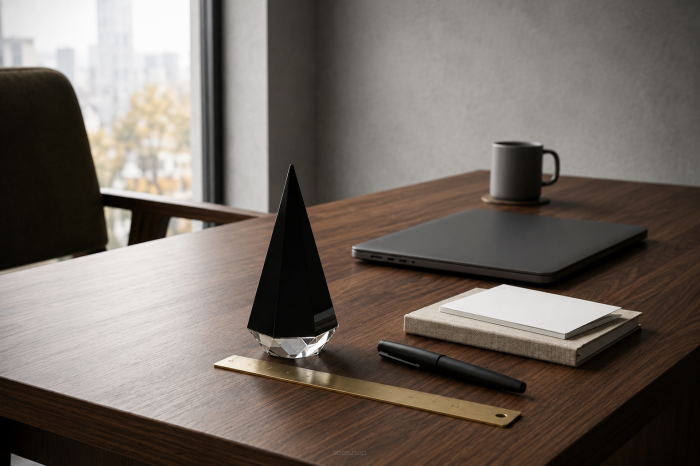
In this context, thoughtfully chosen decorative objects made from natural materials—such as stone, copper, or crystal—can contribute more than visual appeal. They help create a grounded atmosphere and a stronger sense of connection to the space around you.
Temperature and Ventilation: Physiology You Can't Outsmart
As we prepare for sleep, the human body naturally lowers its core temperature by approximately 1–2°C. This is a physiological process, not a metaphor.
When a bedroom is too warm, this process becomes less efficient, making it harder to fall asleep and reducing overall sleep quality.
For most adults, the ideal bedroom temperature falls between 16°C and 19°C. This recommendation is supported by Matthew Walker in Why We Sleep as well as reviews published in Sleep Medicine Reviews.
Why we sleep
...as well as a review published in Sleep Medicine Reviews (Okamoto-Mizuno & Mizuno, 2012).
It may sound surprisingly cool—and for many people, it goes against intuition—but research consistently supports this temperature range. Sleeping in a room that is either too warm or too cold increases the likelihood of nighttime awakenings and reduces REM sleep.
What to Change
If you can't directly control the temperature in your bedroom, ventilate the room before going to sleep. Cooler air before bedtime is one of the simplest—and most overlooked—ways to improve sleep quality.
Your bedding matters just as much. Natural fibers such as cotton, linen, and bamboo are more breathable than synthetic materials and help regulate body temperature throughout the night.
Electromagnetic Fields and Devices: A Topic Worth Approaching with Balance
This is a subject that often divides opinion. Some people dismiss it entirely, while others become convinced of effects that go far beyond the available evidence.
A balanced perspective is the most useful one.
The reality is that research on the health effects of electromagnetic fields (EMFs) is still ongoing, and there is currently no scientific consensus comparable to what exists for sleep, light exposure, or temperature regulation.
What is clear, however, is that electronic devices themselves can negatively affect sleep quality. Studies consistently show that having a smartphone in the bedroom is associated with poorer sleep—not necessarily because of EMFs, but because of notifications, accessibility, blue light exposure, and habitual checking behaviors.
Remove your phone from the bedroom.
Of all the recommendations in this article, this may be the single most effective and best-supported change you can make.
For those interested in creating a more intentional and harmonious environment around electronic devices, shungite has attracted growing interest in recent years. This naturally occurring carbon-rich mineral from Karelia is often incorporated into workspaces and living environments.
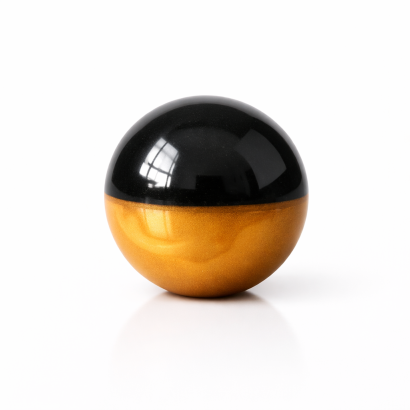
Shungite possesses a unique molecular structure containing fullerenes and has been studied for its distinctive physical properties. Available in the form of spheres, pyramids, and decorative objects—including those found in the LumiPyramids collection—it can serve a dual purpose: a striking design element and a thoughtful choice of natural material in technology-filled spaces.
LumiPyramids –
It can serve a dual purpose: as a sophisticated design accent on a desk and as a thoughtful material choice in environments filled with electronic devices.
The Intention of a Space: The Factor Few People Talk About
There is one aspect of a restorative environment that is difficult to measure, quantify, or analyze scientifically, yet it appears repeatedly in conversations about interior design, meditation, and behavioral psychology: the intention of a space.
When a bedroom simultaneously functions as an office, dining room, and living area, the brain struggles to determine when it should switch into rest mode.
The associations we build over time are powerful. If you regularly answer emails or work on a laptop while sitting in bed, your brain gradually begins to associate the bed with stimulation and productivity rather than relaxation and sleep.
Creating clearly defined zones—even in a small apartment—is one of the foundations of healthy sleep and effective recovery. A workspace, a relaxation area, and an eating area each send different signals to the brain. The boundaries between them do not need to be dramatic; they can be as simple as a different rug, a dedicated lamp, or a few carefully chosen objects.
This is precisely why transition rituals are so effective. Lighting a candle, brewing a cup of tea, spending a few quiet minutes in silence, or sitting with a meaningful object all act as cues that tell the brain: it's time to slow down.
The brain responds well to signals and repetition.
Many people who have introduced meditation pyramids or natural stone objects into their daily routines describe a similar experience. The object becomes a physical anchor for a mental shift—a simple reminder that the day is ending and a different state of mind is beginning.meditation pyramids or smaller objects made from stonei,
Many people who have introduced meditation pyramids or smaller objects made from natural stones into their daily routines describe a similar effect: the object becomes a signal that it is time to shift into a different state of mind.
Not because of magic—but because of repeated association.
A Practical Checklist: From the Simplest Change to the Most Involved
You don't need to do everything at once. Research on habit formation consistently shows that small, specific actions, implemented consistently, produce lasting results.
Here is a step-by-step list, ordered from the easiest change to the most demanding:
-
Remove your smartphone from the bedroom. Buy an alarm clock instead. This one change may have a greater impact than anything else on this list.
-
Replace the bulbs in your bedroom and living room with warm lighting (2700 K). Cost: minimal. Impact: immediate.
-
Clear visible surfaces. Your desk, floor, and windowsill—focus only on what you can see.
-
Air out your bedroom before going to sleep and make sure you're not sleeping in a room that is too warm.
-
Introduce a simple transition ritual: 10–15 minutes without screens before bed. A cup of tea, reading, or simply sitting in silence.
-
Add natural materials to your relaxation space: a plant, a wooden object, a stone, or natural textiles.
-
Define a dedicated relaxation zone. Physically separate it from your workspace, even if that means nothing more than a different rug or lamp.
-
Consider masking background noise with white noise, nature sounds, or thicker curtains.
-
Choose one intentional object—a stone, crystal, or natural decorative piece—and place it in your relaxation space as a signal to your brain: this is where I slow down.
Final Thoughts
Rest is not a passive state that simply happens once work is finished.
It is a physiological process that requires the right conditions—just as cooking requires the right temperature.
Most of us spend years optimizing our productivity and performance. Optimizing recovery is simply the other side of the same equation, and it deserves just as much attention.
Start with one change today.
Looking for natural objects for your relaxation space?
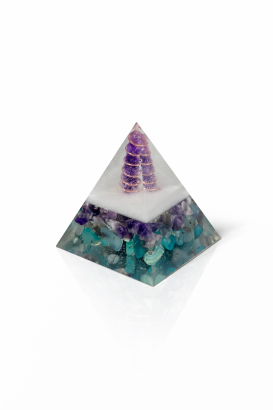
The LumiPyramids collection includes handcrafted pyramids, orgonites, and crystals made from natural stones, with prices starting from 65 PLN.see the collection→



 Polish